Sai Institute of Gastroenterology And Liver Sciences
How Advanced Endoscopy is Replacing Traditional Surgery
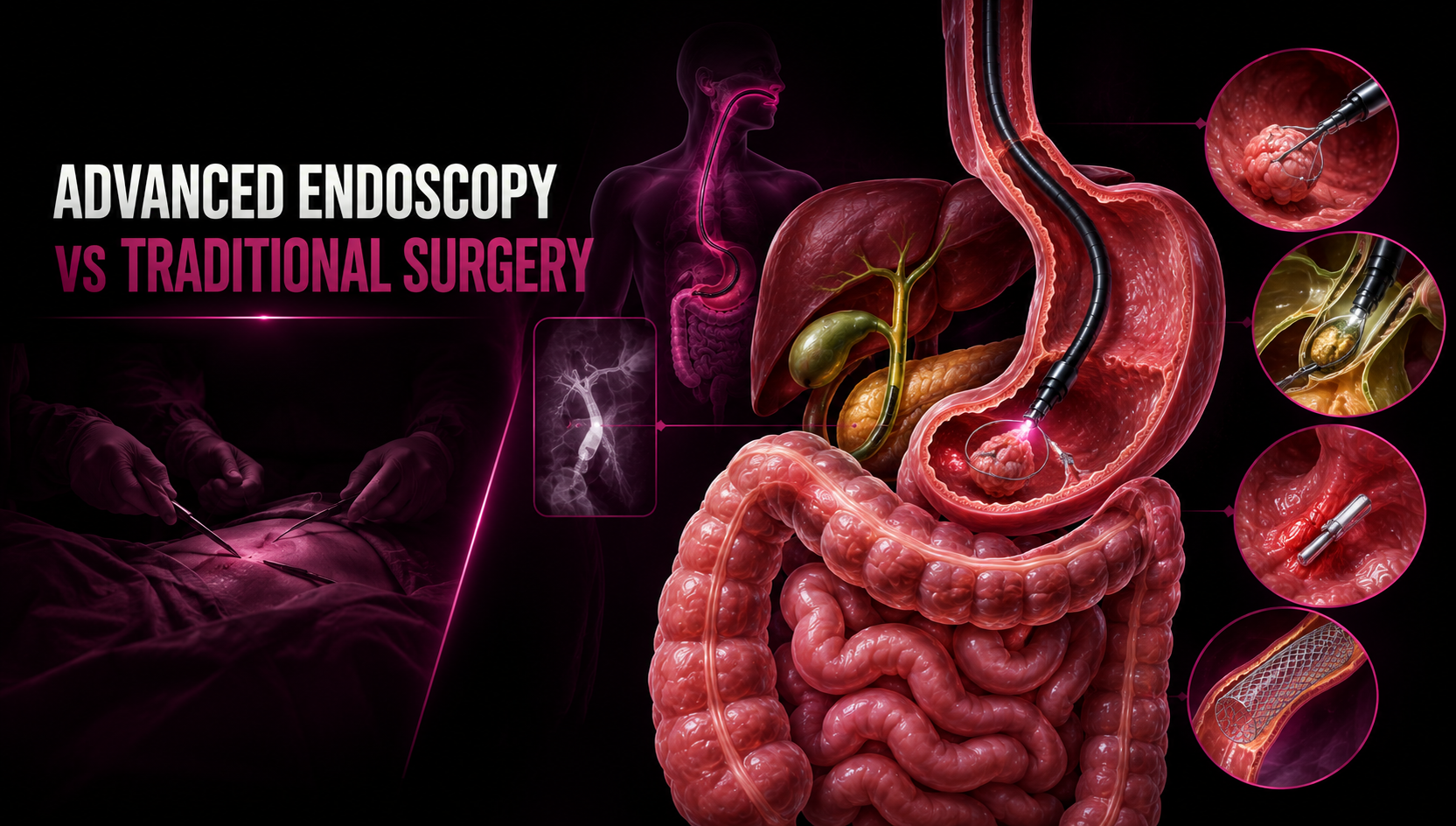
For many years, treating a serious gastrointestinal problem often meant surgery. A tumour needed to be removed, a blocked bile duct needed to be opened, or a difficult lesion required an operation.
But gastrointestinal medicine has changed significantly.
Today, doctors can treat many conditions using advanced endoscopic techniques. Instead of making a large incision, a specialist can sometimes reach the affected area through the digestive tract using a flexible endoscope and specialised instruments.
This doesn’t mean surgery is no longer needed. It means that in selected patients, advanced endoscopy can achieve the same treatment goal with a less invasive approach.
That distinction is important.
The right treatment depends on the disease, its size and location, how deeply it has affected the digestive tract, and the patient’s overall health.
What Is Advanced Endoscopy?
A conventional endoscopy is commonly used to look inside the digestive tract and identify problems such as ulcers, inflammation, polyps, or abnormal growths.
Advanced endoscopy goes beyond diagnosis.
It allows specially trained gastroenterologists to perform complex treatments through an endoscope.
Depending on the condition, advanced endoscopic procedures can be used to:
- Remove certain early cancers and precancerous lesions.
- Remove gastrointestinal polyps.
- Stop internal bleeding.
- Remove stones from the bile duct.
- Open narrowed bile ducts.
- Place stents.
- Close selected gastrointestinal defects or leaks.
- Take targeted tissue samples.
Because these procedures are technically demanding, they require specialised training, appropriate equipment, and careful patient selection.
How Can Endoscopy Avoid Traditional Surgery?
Traditional surgery generally requires an incision to reach the affected organ.
Endoscopic procedures use the body’s natural openings, such as the mouth or rectum, to access the digestive tract.
This means that, for suitable conditions, treatment can be performed without creating a large external surgical wound.
The potential advantages may include:
- Less postoperative discomfort.
- Faster recovery.
- Shorter hospitalisation in selected cases.
- Earlier return to normal activities.
- Preservation of the affected organ in certain treatments.
However, advanced endoscopy should not be described as a completely risk-free alternative to surgery. Some procedures can be highly complex, and complications are possible.
The aim is not simply to avoid surgery. The aim is to provide the safest and most effective treatment for the patient.
ESD: Treating Selected Early Cancers Without Major Surgery
One of the most important developments in therapeutic endoscopy is Endoscopic Submucosal Dissection (ESD).
Some early cancers of the stomach, oesophagus, and colon remain confined to the superficial layers of the digestive tract. When the cancer meets specific criteria, ESD may allow the entire lesion to be removed through an endoscope.
The doctor carefully separates the abnormal tissue from the deeper layers of the digestive wall and removes it, often in one piece.
This has two important advantages.
First, the affected organ can potentially be preserved rather than removing part of it through surgery.
Second, removing the lesion in one piece allows detailed examination by a pathologist to determine whether it has been completely removed and whether there are features suggesting a higher risk of spread.
But ESD isn’t appropriate for every cancer.
The size, location, appearance, depth of invasion, and other characteristics of the lesion all matter. If the cancer has invaded more deeply or has a significant risk of lymph-node spread, surgery or other treatment may be more appropriate.
EMR: Removing Polyps and Selected Early Lesions
Endoscopic Mucosal Resection (EMR) is another technique used to remove certain polyps, precancerous lesions, and selected early cancers.
Instead of surgically removing a section of the stomach or bowel, the abnormal tissue can sometimes be lifted and removed through the endoscope.
EMR is particularly useful for appropriately selected lesions that can be safely removed using this technique.
For larger or more complex lesions, ESD or surgery may provide a better option.
Again, the decision isn’t about choosing the procedure that sounds least invasive. It is about choosing the treatment that offers the best chance of complete and safe removal.
ERCP: Treating Bile Duct Problems Without an Operation
A common example is a stone that has moved from the gallbladder into the common bile duct.
During Endoscopic Retrograde Cholangiopancreatography (ERCP), a specialised endoscope is passed through the mouth into the small intestine. The doctor can then access the bile duct using specialised instruments.
Depending on the problem, ERCP can be used to:
- Remove bile duct stones.
- Relieve blockages.
- Treat certain narrowed ducts.
- Place stents to improve drainage.
- Manage selected bile leaks.
For many patients, this means that a bile duct obstruction can be treated without a separate surgical procedure.
ERCP is now primarily a therapeutic procedure, while less invasive imaging tests such as ultrasound, CT, or MRCP are often used when the goal is simply to investigate the bile and pancreatic ducts.
Controlling Gastrointestinal Bleeding
Advanced endoscopy can also play an important role when a patient develops gastrointestinal bleeding.
Bleeding from ulcers, abnormal blood vessels, polyps, or other lesions can sometimes be identified and treated during the same endoscopic procedure.
Depending on the cause, doctors may use:
- Endoscopic clips.
- Thermal therapy.
- Injection techniques.
- Haemostatic powders or other specialised devices.
This can control bleeding and, in selected cases, reduce the need for emergency surgery.
Endoscopic Closure and Suturing
Endoscopic technology has moved beyond removing tissue and controlling bleeding.
Specialised closure and suturing techniques can now be used in selected situations to close gastrointestinal defects or leaks.
Endoscopic suturing allows doctors to place stitches internally through an endoscope, without creating a traditional surgical incision.
The technique may be considered for certain gastrointestinal defects, leaks, or selected situations following advanced endoscopic procedures.
Whether it is appropriate depends on the size, location, cause, and characteristics of the problem.
Does Advanced Endoscopy Mean Surgery Is No Longer Needed?
No.
Advanced endoscopy has expanded the number of conditions that can be treated without conventional surgery, but it has not made surgery obsolete.
Surgery may still be the better option when:
- A cancer has invaded deeply into surrounding tissue.
- There is a significant risk of lymph-node involvement.
- A lesion cannot be completely removed endoscopically.
- The disease extends beyond an area that can be safely reached or treated through an endoscope.
- A serious complication requires surgical intervention.
In other words, the question shouldn’t be:
“Can we avoid surgery?”
It should be:
“Which treatment gives this patient the best and safest outcome?”
How Do Doctors Choose Between Endoscopy and Surgery?
The decision is based on several factors.
Type of Disease
A bile duct stone, early cancer, bleeding ulcer, and gastrointestinal leak all require different approaches.
Size and Location
The size and exact location of a lesion can determine whether it can be safely treated endoscopically.
Depth of Invasion
For cancer, the depth to which the tumour has entered the digestive wall is particularly important.
Risk of Spread
If there is a significant possibility that cancer has spread to lymph nodes or elsewhere, surgery or additional cancer treatment may be necessary.
Overall Health
A patient’s age, medical conditions, previous procedures, and general health also influence treatment decisions.
Specialist Expertise
Advanced procedures such as ESD and complex ERCP require specialised expertise and appropriate facilities.
Frequently Asked Questions
Can advanced endoscopy completely replace surgery?
No. It can replace surgery for certain conditions in carefully selected patients, but surgery remains essential for many gastrointestinal diseases.
Is advanced endoscopy safer than surgery?
It is less invasive for many procedures, but it is not risk-free. Both approaches have potential complications, and the appropriate treatment depends on the patient’s individual condition.
Can stomach cancer be treated through an endoscope?
Some early stomach cancers may be suitable for endoscopic treatment such as ESD. More advanced cancers may require surgery or other cancer treatments.
Does advanced endoscopy require hospitalisation?
That depends on the procedure and the patient’s condition. Some procedures can be performed with a short observation period, while complex treatments may require hospitalisation.
Who decides whether I need endoscopy or surgery?
An experienced specialist evaluates the disease, imaging, endoscopic findings, biopsy results, and overall health before recommending the most appropriate treatment. In complex cases, multiple specialists may contribute to the decision.
The Future of Gastrointestinal Treatment
The progress of advanced endoscopy is changing what doctors can accomplish without traditional surgery.
Early gastrointestinal cancers can sometimes be removed while preserving the organ. Bile duct stones can often be treated through ERCP. Gastrointestinal bleeding can be controlled endoscopically, and selected defects can be closed using advanced endoscopic techniques.
But the real advancement isn’t about replacing every operation.
It is about giving patients more treatment options.
When an endoscopic procedure can safely provide complete and effective treatment, avoiding a major operation can be a significant benefit. When surgery offers the better outcome, it remains the right choice.
The best treatment is not necessarily the newest or least invasive one.
It is the treatment that is right for the patient.
Advanced Endoscopy at SIGLS
At Sai Institute of Gastroenterology & Liver Sciences (SIGLS), advanced endoscopic procedures are used for the diagnosis and treatment of a range of gastrointestinal conditions.
Procedures such as ESD, EMR, ERCP, and other therapeutic endoscopic techniques require specialised expertise and careful patient selection.
At SIGLS, treatment decisions are made according to the individual patient’s condition, with the focus on achieving safe, effective treatment while considering less invasive options whenever appropriate.
For some patients, that may mean advanced endoscopy instead of traditional surgery. For others, surgery may remain the most appropriate treatment.
The important thing is having the expertise and technology to determine which approach is right for you.